
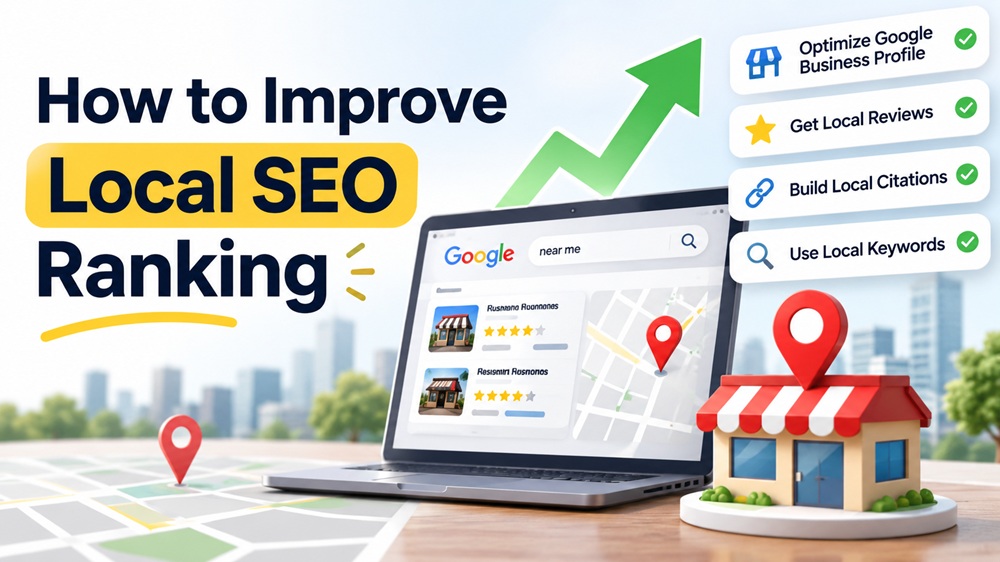
Local SEO helps businesses appear when potential customers search for products or services in their area. Whether someone searches for a dentist nearby, a web designer in their city, or an emergency plumber, strong local search visibility helps businesses reach people who are actively looking for what they offer.
To improve local SEO ranking, start by optimizing your Google Business Profile, researching relevant local keywords, improving your website’s service and location pages, earning genuine customer reviews, and building relevant local authority. You should also monitor your visibility across different geographic areas and measure how many enquiries your search presence generates.
However, local SEO involves more than optimizing a Google Business Profile or collecting reviews. Businesses need to build a consistent presence across Google Maps, local organic search results and relevant online platforms.
This guide explains 15 practical strategies to improve local SEO rankings, increase Google Maps visibility and attract more relevant customers.
What Is Local SEO and How Does It Work?
Local SEO (local search engine optimization) is the process of improving a business’s visibility in search results for location-related searches.
It helps businesses connect with people searching for nearby products, services or businesses in a specific geographic area.
For example, these searches demonstrate local search intent:
-
Web design company in Colombo
-
Best restaurant near me
-
Emergency plumber in London
-
Dentist in Melbourne
-
SEO agency near me
Google can display local businesses in Google Maps, the Local Pack and regular organic search results.
Google Maps vs Local Pack vs Local Organic Results
These search features are related, but they are not identical.
| Search result | What it displays | Main optimization focus |
|---|---|---|
| Google Maps | Businesses displayed within Google Maps | Business Profile accuracy, relevance and prominence |
| Local Pack | A selection of local businesses within Google Search | Relevance, distance and prominence |
| Local organic results | Website pages appearing in regular search results | Content relevance, technical SEO and website authority |
A business can appear in organic search results without appearing in the Local Pack. Similarly, a Google Business Profile can appear in Maps even when the business website does not rank prominently in traditional organic results.
For this reason, an effective local SEO strategy should address both your business listing and your website.
What Are Google’s Three Main Local Ranking Factors?
Google identifies three primary factors behind local search rankings: relevance, distance and prominence.
1. Relevance
Relevance describes how closely a Business Profile matches what someone searches for.
Accurate business categories, services and business information help Google understand what your business offers.
2. Distance
Distance refers to how far a business is from the searcher or the location specified in a search.
You cannot directly optimize your physical proximity to a customer. This is why a business may rank differently across different neighborhoods.
3. Prominence
Prominence describes how well-known a business is. Google considers information such as links to the business and customer reviews.
Positive ratings and reviews can contribute to local prominence.
These factors explain why optimizing a business profile alone cannot guarantee top Google Maps positions. You need to build relevance and prominence while recognizing the geographic limitations of distance.
Source: Google’s official local ranking guidance.
How to Improve Local SEO Ranking: 15 Practical Strategies
1. Optimize Your Google Business Profile
Your Google Business Profile is an important part of improving visibility in Google Maps and local search results.
It provides information about your business, including its name, location, categories, services, opening hours and contact details.
Start by claiming and verifying your profile.
Then review the following elements.
Choose the most relevant primary business category
Select the category that best represents your main business.
For example:
-
A dentist should select Dentist.
-
A plumbing company should select Plumber.
-
A restaurant should select the most appropriate restaurant category.
Add secondary categories only when they accurately describe additional services your business provides.
Complete your business information
Ensure your profile contains accurate information:
-
Real business name.
-
Correct address, where customers visit your premises.
-
Main business phone number.
-
Website URL.
-
Business hours and special hours.
-
Accurate business description.
-
Relevant services.
-
Appropriate business attributes.
-
Service areas, where applicable.
Your business name should match its real-world name. Do not add unnecessary keywords to manipulate search rankings.
Add genuine business photos and videos
Upload authentic photographs of your premises, products, services, team and completed projects.
For example, a roofing company can showcase completed roofing projects, while a restaurant can display its dining area and food.
These visuals help potential customers understand what your business offers. Do not use stock images as though they represent your actual business.
Keep your information updated
Update your profile whenever your address, telephone number, opening hours or services change.
Google recommends complete and accurate Business Profile information to help businesses appear for relevant local searches.
2. Conduct Local Keyword Research
Local keyword research helps you identify the searches potential customers use when looking for businesses in your service area.
Instead of targeting only broad service keywords, research terms that combine services, locations and customer needs.
For example, a web development company might target:
-
Web design company in Colombo
-
Website development services in Colombo
-
Ecommerce website development Colombo
-
WordPress developer near me
-
Website redesign services
How to find local keywords
Use these research methods:
-
Google Autocomplete: Enter a service and location to discover suggested searches.
-
Google Keyword Planner: Research keyword ideas and search-volume estimates for your target locations.
-
Google Search Console: Identify queries already generating impressions and clicks.
-
Competitor research: Examine the services, location pages and content of competing businesses.
-
Customer questions: Identify the questions potential customers ask before contacting your business.
SEO platforms such as Semrush and Ahrefs can also help identify keyword opportunities.
Map keywords to the correct pages
Avoid creating a separate page for every minor variation of the same keyword.
Group related searches according to their intent.
| Keyword | Search intent | Recommended page |
|---|---|---|
| Web design company in Colombo | Commercial | Main service or location page |
| Ecommerce website development Colombo | Commercial | Ecommerce service page |
| WordPress website developer Colombo | Commercial | WordPress service page |
| Website design cost in Colombo | Informational/commercial | Pricing guide |
| How to choose a web design company | Informational | Blog article |
This approach creates a more organized website and reduces the risk of multiple pages competing for the same search intent.
3. Optimize Your Website for Local Search
Your website should clearly communicate what your business offers, which customers you serve and where you operate.
Even if your Google Business Profile is well optimized, a poorly structured website can limit your ability to attract local organic traffic.
Focus on these on-page SEO elements.
Optimize title tags
Include your main service and location naturally when relevant.
Example:
Web Design Company in Colombo | Professional Website Development
Write useful meta descriptions
Explain what your business offers and why someone should visit the page.
Example:
“Looking for a professional web design company in Colombo? Explore website design, WordPress development and ecommerce solutions for your business.”
Use descriptive headings
Organize content using a logical heading hierarchy.
For example:
-
H1: Web Design Services in Colombo
-
H2: Professional Website Design Solutions
-
H2: Our Website Development Services
-
H2: Why Choose Our Web Design Company?
Include relevant location information
Mention the locations your business genuinely serves, relevant service areas and local customer information.
Avoid inserting city names into every paragraph. Location information should help visitors understand whether your business is relevant to them.
Make contact information easy to find
Include relevant details such as:
-
Business phone number.
-
Business address, where applicable.
-
Contact form.
-
Business hours.
-
Service areas.
-
Directions, where relevant.
Keep the information consistent with your Google Business Profile.
4. Create Useful Location Pages
If your business operates in multiple locations or genuinely serves customers across several geographic areas, location pages can help you reach relevant local searches.
However, creating dozens of nearly identical pages with only city names changed is not a good strategy.
Each location page should provide meaningful information.
What should a useful location page include?
| Element | What to include |
|---|---|
| H1 heading | Main service and relevant location |
| Introduction | Services available in the area |
| Service information | Relevant products or services |
| Local information | Areas genuinely covered |
| Customer evidence | Genuine testimonials or relevant projects |
| Contact information | Accurate contact details |
| FAQs | Questions relevant to customers in that area |
| CTA | Encourage calls or enquiries |
For example, a web development company could create a Colombo service page describing its website design solutions, ecommerce development, project process and relevant client work.
Only create pages where you can provide genuinely useful information.
Avoid doorway pages
Doorway pages are created primarily to rank for similar search queries and funnel visitors to the same destination.
Instead of publishing 50 generic pages, focus on a smaller number of useful, well-developed location pages.
5. Get More Genuine Customer Reviews
Customer reviews contribute to business reputation and can help improve local prominence.
Google states that more reviews and positive ratings can help a business’s local ranking. Reviews also help potential customers evaluate a business before making contact.
How to encourage genuine reviews
Develop a repeatable process:
-
Complete the service or transaction.
-
Invite the customer to share honest feedback.
-
Provide your Google review link.
-
Make it easy for customers to leave a review.
-
Monitor new reviews.
-
Respond professionally.
You can share the review link through follow-up emails, WhatsApp messages, post-purchase communications or QR codes.
Ask customers for honest feedback without pressuring them to leave positive ratings.
Respond to positive and negative reviews
A professional response acknowledges the customer’s experience and addresses relevant feedback.
For example:
Customer review:
“Excellent service. The team delivered our website on time and provided great support.”
Business response:
“Thank you for your feedback! We’re glad you had a positive experience with our website development team. We appreciate your trust and look forward to supporting your business again.”
Never purchase reviews, offer discounts in exchange for positive ratings, or selectively request reviews only from satisfied customers.
Google prohibits fake engagement and incentivized reviews.
6. Build Consistent Local Citations
A local citation is an online mention of your business information, often including its name, address and phone number (NAP).
Citations can appear on:
-
Business directories.
-
Industry-specific websites.
-
Local business associations.
-
Chambers of commerce.
-
Review platforms.
-
Professional directories.
-
Local publications.
How to audit local citations
Start by recording your official business information.
| Business information | Example |
|---|---|
| Business name | ABC Plumbing Services |
| Address | 25 Main Street, Colombo |
| Phone | +94 XX XXX XXXX |
| Website | www.example.com |
| Category | Plumbing service |
Check existing listings for:
-
Incorrect business names.
-
Old phone numbers.
-
Outdated addresses.
-
Duplicate listings.
-
Incorrect website URLs.
-
Inconsistent opening hours.
Correct inaccurate information and prioritize trustworthy, relevant directories.
Citation consistency is useful for accurate business identification and customer discovery. However, there is no Google-published rule that a particular number of citations will improve rankings.
7. Build Relevant Local Backlinks
Backlinks are links from other websites pointing to your website.
Relevant, trustworthy links can help establish your website’s authority and contribute to local prominence.
Focus on earning links from websites connected to your industry, customers or geographic area.
Practical local link-building opportunities
| Method | Example |
|---|---|
| Local partnerships | Collaborate with complementary businesses |
| Local publications | Contribute useful industry articles |
| Community organizations | Support relevant community initiatives |
| Local events | Sponsor legitimate community events |
| Industry associations | Join relevant professional organizations |
| Local resources | Publish useful guides that others may reference |
For example, a web development agency could publish a practical guide about website security for small businesses. A local business association might reference that resource in its educational materials.
Prioritize relevance and editorial value rather than backlink quantity.
Avoid buying large quantities of links or participating in link schemes designed to manipulate rankings.
8. Improve Website Speed and Mobile Experience
Many customers discover local businesses using smartphones.
A website that loads slowly, displays incorrectly or makes contacting the business difficult can create a poor user experience.
Focus on:
-
Compressing large images.
-
Using WebP or AVIF where appropriate.
-
Enabling browser caching.
-
Minimizing unnecessary scripts.
-
Using reliable hosting.
-
Making navigation mobile-friendly.
-
Ensuring buttons are easy to tap.
-
Making contact forms simple to complete.
-
Making phone numbers clickable.
Monitor Core Web Vitals
Google recommends monitoring three Core Web Vitals metrics.
| Metric | What it measures | Good threshold |
|---|---|---|
| LCP | Loading performance | 2.5 seconds or less |
| INP | Responsiveness | 200 milliseconds or less |
| CLS | Visual stability | 0.1 or less |
These thresholds apply to the 75th percentile of real-world page loads.
Use Google PageSpeed Insights and Search Console to identify performance issues.
Core Web Vitals are part of Google’s page experience considerations for Search. However, a perfect PageSpeed score does not guarantee better organic rankings or Google Maps positions.
9. Implement LocalBusiness Schema Markup
Structured data helps search engines understand information about your business.
For eligible business websites, LocalBusiness structured data can describe information such as:
-
Business name.
-
Address.
-
Telephone number.
-
Opening hours.
-
Geographic coordinates.
-
Website URL.
-
Business type.
An illustrative JSON-LD example:
<script type="application/ld+json">
{
  "@context": "https://schema.org",
  "@type": "LocalBusiness",
  "name": "ABC Plumbing Services",
  "url": "https://www.example.com/",
  "telephone": "+94XXXXXXXXX",
  "address": {
    "@type": "PostalAddress",
    "streetAddress": "25 Main Street",
    "addressLocality": "Colombo",
    "addressCountry": "LK"
  },
  "openingHours": "Mo-Sa 08:00-18:00"
}
</script>
This is an example only. Replace the information with accurate business details and choose a more specific business subtype when appropriate.
For businesses with multiple legitimate locations, use accurate information for each location.
Structured data does not guarantee higher rankings or rich results. Its purpose is to help search engines understand eligible information about your business.
Follow Google’s LocalBusiness structured data documentation when implementing schema.
10. Improve Your Website’s Internal Linking
Internal links connect different pages on your website and help visitors discover related information.
They also help search engines discover pages and understand your website structure.
For local SEO, internal linking is especially useful when a business has multiple services and location pages.
For example, a web development company might organize its website around:
-
Homepage.
-
Web design services.
-
SEO services.
-
Ecommerce development.
-
Location pages.
-
Supporting blog articles.
Internal linking best practices
-
Link relevant blog articles to service pages.
-
Connect location pages to the services available in those areas.
-
Link related supporting articles together.
-
Use descriptive anchor text.
-
Avoid repetitive exact-match anchors.
-
Ensure important pages are accessible through normal website navigation.
For example, a guide about local SEO can naturally link to a relevant SEO service page when readers want professional assistance.
11. Add Authentic Business Photos and Videos
Authentic visual content helps customers understand your business before contacting you.
Consider adding:
-
Exterior and interior photographs.
-
Team photographs.
-
Products and services.
-
Completed projects.
-
Customer-facing facilities.
-
Demonstrations of your work.
For example, a restaurant can showcase its food and dining area, while a construction company can publish photographs of completed projects.
Use descriptive filenames and meaningful alt text when appropriate.
Example:
Filename: colombo-web-design-project.webp
Alt text: Website design project completed for a business in Colombo
Avoid stuffing location keywords into every image’s alt text.
Also, do not treat EXIF geotagging as a ranking shortcut. There is no established Google guidance that adding GPS metadata to photographs directly improves Google Maps rankings.
12. Publish Useful, Location-Relevant Content
Publishing helpful content gives customers more reasons to visit your website and helps demonstrate your expertise.
Focus on questions and problems that matter to your target customers.
For example, a web development agency could publish:
| Article topic | Target audience |
|---|---|
| How Much Does Website Design Cost? | Businesses planning a new website |
| WordPress vs Laravel | Businesses choosing a development platform |
| Do I Need a Website for My Business? | Small business owners |
| How to Improve Local SEO Ranking | Businesses seeking local visibility |
| Ecommerce Website Development Guide | Businesses planning online sales |
Make content more useful through:
-
Local market examples.
-
Relevant regulations or business considerations.
-
Original project examples.
-
Expert explanations.
-
Answers to genuine customer questions.
-
Practical recommendations.
Do not create large numbers of generic location articles simply to insert geographic keywords.
13. Optimize for Multiple Business Locations
Businesses with multiple genuine branches need a local SEO strategy that accurately represents each location.
For every eligible location:
-
Maintain an accurate Google Business Profile.
-
Use the correct business address and contact details.
-
Create a dedicated location page where it provides genuine value.
-
Describe the services available at that location.
-
Include relevant local information and genuine customer evidence.
-
Keep business hours updated.
-
Monitor performance separately.
What about service-area businesses?
Businesses that travel to customers, such as plumbers, cleaners and mobile repair services, may qualify for a service-area Business Profile.
If customers are not served at the business address, the address should generally be hidden from the public profile.
Use accurate service areas based on where the business actually operates.
Do not create fake offices, virtual locations or additional profiles simply to rank in more cities.
Review Google’s Business Profile guidelines before creating or modifying profiles.
14. Track Local SEO Rankings and Google Maps Visibility
Local search results can vary depending on where someone searches.
A dentist may appear prominently near their clinic but rank lower when someone searches from another neighborhood.
For this reason, checking a keyword from one computer or location does not provide a complete picture of local visibility.
Use the right tools to measure performance
| Tool | What to monitor |
|---|---|
| Google Business Profile Performance | Searches, views, calls, website clicks and other available interactions |
| Google Search Console | Organic queries, impressions, clicks and page performance |
| Google Analytics 4 | Website visits and conversions |
| Local rank tracking software | Geographic ranking differences |
| Google PageSpeed Insights | Website performance |
Track rankings across geographic areas
For a business serving multiple neighborhoods, use geographic rank tracking to understand where it appears in Maps and local search results.
Monitor:
-
Local Pack visibility.
-
Google Maps rankings.
-
Organic keyword positions.
-
Geographic ranking differences.
-
Competitor visibility.
-
Organic search impressions and clicks.
Measure enquiries and conversions
Rankings alone do not demonstrate business success.
Track:
-
Telephone enquiries.
-
Contact form submissions.
-
WhatsApp enquiries.
-
Appointment bookings.
-
Qualified leads.
-
Sales.
Google Business Profile Performance can also show customer interactions, including calls, website clicks and directions where those metrics are available.
Compare results over consistent periods rather than judging progress from isolated ranking checks.
15. Maintain Accurate Business Information Beyond Google
Customers can discover businesses through other search engines, maps and relevant directories.
Consider maintaining accurate information on:
-
Bing Places for Business.
-
Apple Business.
-
Relevant industry directories.
-
Local review platforms.
-
Professional association websites.
Keep important business information consistent, including your business name, address, telephone number and website.
AI-powered search tools are another discovery channel worth monitoring. However, do not treat appearing in AI-generated answers as a guaranteed way to improve Google Maps rankings.
Your foundation should remain accurate business information, helpful website content, genuine customer reputation and relevant authority.
How to Prioritize Your Local SEO Improvements
If you have limited time or budget, you do not need to implement all 15 strategies simultaneously.
Use this prioritization framework to organize your work.
| Priority | Action | Objective |
|---|---|---|
| 1 | Verify profile eligibility and correct inaccurate information | Establish an accurate business presence |
| 2 | Fix major website and indexing problems | Make important pages accessible |
| 3 | Research local keywords and search intent | Target relevant searches |
| 4 | Improve service and location pages | Strengthen website relevance |
| 5 | Establish a genuine review process | Build reputation and trust |
| 6 | Correct important business citations | Improve information consistency |
| 7 | Earn relevant local backlinks | Develop authority |
| 8 | Track rankings, enquiries and conversions | Measure performance and identify gaps |
This is a practical implementation order, not an official Google ranking-factor hierarchy.
Common Local SEO Mistakes to Avoid
Even when following good SEO practices, certain mistakes can damage your local search presence or waste your optimization budget.
Avoid these common problems:
1. Adding keywords to your Google Business Profile name
Use the real-world business name, not a keyword-stuffed version.
2. Creating fake business locations
Only create profiles for eligible, legitimate business locations.
3. Buying Google reviews
Fake and incentivized reviews violate Google’s policies.
4. Publishing duplicate location pages
Changing only the city name across multiple pages provides little additional value.
5. Ignoring customer feedback
Respond professionally to reviews and address legitimate complaints.
6. Building irrelevant backlinks
Prioritize relevant and trustworthy links rather than link quantity.
7. Treating geotagged photos as a ranking shortcut
Upload useful, genuine photographs without relying on unsupported geotagging claims.
8. Checking rankings from only one location
Monitor geographic differences to understand your actual local visibility.
How Long Does It Take to Improve Local SEO Rankings?
There is no fixed timeline for improving local SEO rankings.
Correcting inaccurate business information or improving an incomplete profile may make your listing more useful relatively quickly.
However, building website authority, developing useful content, improving reputation and competing in established markets can take considerably longer.
Progress depends on:
| Factor | How it affects progress |
|---|---|
| Existing Business Profile | An accurate and established profile provides a better starting point |
| Local competition | Competitive markets may require more work to build prominence |
| Website quality | Technical and content improvements may be needed |
| Customer reviews | Genuine reputation development takes time |
| Backlink profile | Building relevant authority requires sustained effort |
| Business location | Distance influences which searches a business can realistically appear for |
| SEO consistency | Ongoing maintenance helps preserve accuracy and usefulness |
Review progress over the first 90 days, but understand that meaningful ranking improvements may take longer.
Avoid agencies promising guaranteed first-place rankings within a specific number of days. Google does not offer a paid shortcut to better organic local rankings.
Local SEO Checklist for Small Businesses
Use this checklist to identify the most important tasks for improving your local search visibility.
Google Business Profile
-
Claim and verify your eligible business profile.
-
Choose the most relevant primary category.
-
Add accurate business information.
-
Update opening hours and special hours.
-
Add relevant services.
-
Upload genuine business photos and videos.
-
Review and update service areas.
Keyword and website optimization
-
Research service and location keywords.
-
Optimize title tags and meta descriptions.
-
Improve heading structure.
-
Create useful location pages where appropriate.
-
Optimize important service pages.
-
Add relevant internal links.
-
Improve mobile usability and website performance.
Reputation and authority
-
Establish a genuine review request process.
-
Respond to customer reviews.
-
Correct inaccurate business listings.
-
Audit NAP consistency.
-
Earn relevant local backlinks.
-
Publish useful, original content.
Technical SEO and measurement
-
Implement appropriate LocalBusiness schema.
-
Check indexing and XML sitemap.
-
Validate structured data.
-
Monitor Core Web Vitals.
-
Track local rankings across geographic areas.
-
Monitor Search Console and Business Profile Performance.
-
Measure calls, enquiries and conversions.
Frequently Asked Questions About Improving Local SEO Rankings
1. How can I improve my local SEO ranking quickly?
Start by correcting your Google Business Profile information, selecting the most relevant business categories, updating your services and hours, and ensuring your website accurately describes your business.
Then address important technical problems, review your local keyword targeting and establish a genuine customer review process.
No specific ranking improvement is guaranteed.
2. How do I rank higher on Google Maps?
Optimize your Google Business Profile, provide accurate business information, choose relevant categories, respond to customer reviews and develop your business’s prominence.
Remember that distance also influences Maps results. Your business may rank differently depending on where the searcher is located.
3. Does Google Business Profile help local SEO?
Yes. Google Business Profile helps Google understand your business and can help it appear in Google Maps and local search results.
Maintain accurate information, relevant categories, services and opening hours.
4. How many Google reviews do I need to rank higher?
There is no fixed number of reviews required to rank in Google’s Local Pack.
Google considers relevance, distance and prominence. Reviews and positive ratings can contribute to prominence, but having more reviews than a competitor does not guarantee a higher ranking.
Focus on collecting genuine customer feedback consistently.
5. Do backlinks help local SEO rankings?
Relevant backlinks can help establish website authority and contribute to local prominence.
Prioritize links from reputable local publications, relevant industry websites, community organizations and legitimate business partnerships.
6. How important are local citations for SEO?
Local citations help maintain accurate business information across the web and can support business discovery.
Prioritize relevant directories and correct inaccurate listings. Submitting your website to hundreds of directories does not guarantee higher rankings.
7. Can a business rank locally without a physical storefront?
Yes. Eligible service-area businesses can have Google Business Profiles even when customers do not visit a public storefront.
For example, plumbers, cleaners and mobile repair businesses may qualify.
They must follow Google’s eligibility requirements and accurately represent where they operate.
8. How long does local SEO take to show results?
There is no universal timeline.
Some profile corrections can be made quickly, while building website authority, local relevance and customer reputation can take longer.
Evaluate progress using consistent ranking, traffic and conversion measurements.
9. Does posting on Google Business Profile improve rankings?
Google Business Profile posts can communicate offers, events, updates and business information to customers.
However, publishing posts frequently is not a guaranteed way to improve rankings. Focus on useful updates rather than posting purely for SEO.
10. Is local SEO different from traditional SEO?
Yes. Both involve improving search visibility, but local SEO has an additional geographic focus.
Traditional SEO concentrates on website relevance, content, technical performance and authority.
Local SEO also considers Google Business Profile information, physical proximity, business prominence, reviews and local search intent.
Need Professional Help Improving Your Local SEO Rankings?
Improving local search visibility requires a combination of website optimization, technical SEO, keyword research, content development and ongoing performance analysis.
Businesses that lack the time or expertise to manage these activities can benefit from professional SEO support.
Tectera provides SEO services covering:
-
SEO audits and competitor analysis.
-
Keyword research.
-
On-page SEO optimization.
-
Technical SEO.
-
Website content optimization.
-
Internal linking improvements.
-
Link-building strategies.
-
Search performance monitoring.
If you want to improve your website’s organic visibility and develop a stronger SEO strategy, explore Tectera’s SEO services.
You can also contact Tectera to discuss your website’s SEO requirements.
Conclusion
Improving local SEO rankings requires more than optimizing a Google Business Profile. Businesses need to build a strong local search presence through accurate business information, relevant website content, genuine customer reviews, consistent citations and authoritative backlinks.
Start with the fundamentals: verify and optimize your Google Business Profile, research the keywords your customers use, improve your service pages and make your website easy to use on mobile devices.
Then develop your business’s local reputation, earn relevant backlinks and monitor your visibility across different geographic areas.
Most importantly, measure calls, enquiries and customers rather than relying only on ranking positions. A sustainable local SEO strategy should make your business easier to discover, easier to trust and easier to contact.

