
Wants to know how to start a dropshipping business in Sri Lanka?
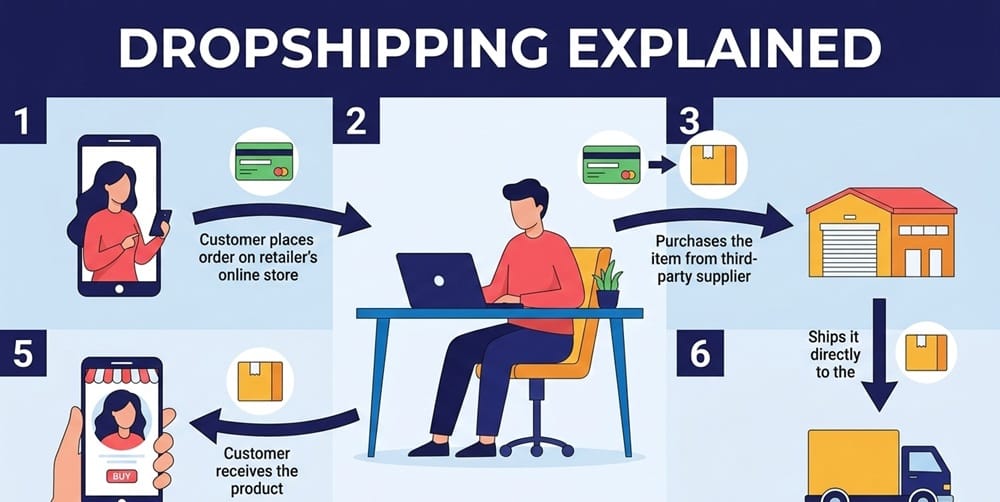
Dropshipping is a modern e-commerce model to sell products online without a physical inventory. A customer places an order, and the product gets shipped directly from the supplier to the buyer.
You can run a business with minimal upfront investment, no warehouse, and far less operational hassle. In Sri Lanka, dropshipping is gaining momentum as more people explore online business opportunities.
Low startup costs make it accessible to Lankan students, side hustlers, and budding entrepreneurs. This insightful guide should fulfill anyone’s curiosity about starting a dropshipping venture in Sri Lanka.
How Does Dropshipping Differ from Traditional Retail?
Customer browses your online store and places an order. You receive payment and forward the order to the supplier. Supplier ships the product directly to the customer, with neutral or customized packaging.
In total, Profit = Selling Price – Supplier Price – Marketing Costs. This flow eliminates the need for warehouses, bulk purchasing, or complicated logistics.
Traditional Retail vs Dropshipping
| Aspect | Traditional Retail | Dropshipping |
| Inventory | Retailer buys and stores products upfront | No inventory needed |
| Capital Requirement | High (bulk purchasing, warehousing) | Low (pay the supplier only after the sale) |
| Risk | Unsold stock, storage costs | Minimal risk, as you buy only after demand |
| Logistics | Retailer manages shipping | Supplier handles shipping |
| Focus | Operations + sales | Marketing + customer acquisition |
Imagine a Sri Lankan student starting a small online store selling trendy phone cases. Instead of importing and storing hundreds of cases, they partner with a supplier in China via platforms like AliExpress or CJ Dropshipping.
A customer in Colombo orders a phone case for LKR 1,500. The supplier charges LKR 700 for the same case. The student spends LKR 300 on Facebook ads to attract buyers. Net Profit = 1,500 – 700 – 300 = LKR 500 per sale.
How Much Can You Earn from Dropshipping in Sri Lanka?
Profit Margin Examples
Dropshipping margins vary depending on product type, supplier costs, and ad spend.
Typical global margins: 20%–40% per sale.
Margins often range from LKR 500–2,000 per item, depending on the niche (fashion, beauty, gadgets). High-ticket items (electronics, fitness equipment) can yield larger profits but require bigger ad budgets.
Revenue Scenario Breakdown
- Scenario: 5 Sales/Day
- Average selling price: LKR 3,000
- Supplier cost: LKR 1,200
- Ad spend per sale: LKR 500
- Platform/transaction fees: LKR 300
Profit per sale = 3,000 – 1,200 – 500 – 300 = LKR 1,000
- Daily Profit = 5 × 1,000 = LKR 5,000
- Monthly Profit (30 days) = LKR 150,000
It’s a realistic starting point for a small-scale dropshipper. Scaling to 20–30 sales/day could push monthly profits into the LKR 600,000–900,000 range, but only with strong marketing and reliable suppliers.
Realistic Expectations
Dropshipping is not a get-rich-quick scheme. Many beginners break even or make small profits in the first 3–6 months while testing products and ads.
In Sri Lanka, COD refusals and shipping delays can reduce margins, so transparency and customer service are critical.
Scalability Factors
- Niche selection: High-demand, low-competition products scale faster.
- Ad optimization: Testing creatives and audiences reduces cost per acquisition.
- Supplier reliability: Faster shipping = happier customers = repeat sales.
- Platform choice: Shopify/WooCommerce automation saves time, enabling scaling.
- Customer retention: Repeat buyers increase lifetime value without extra ad spend.
Suggested Read: Top 10 online E- Commerce websites in Sri Lanka
Is Dropshipping Legal in Sri Lanka?
Business Registration Requirements
To operate a dropshipping business in Sri Lanka, you must register your business with the Department of Registrar of Companies (DRC) or the Divisional Secretariat, depending on your chosen structure.
- Sole Proprietorship: Easiest to set up, suitable for students or side hustlers.
- Partnership: Ideal if two or more individuals want to share responsibilities and profits.
- Private Limited Company (Pvt Ltd): Recommended for entrepreneurs and SMEs aiming to scale, as it offers liability protection and credibility with suppliers and customers.
Registering ensures you can legally open bank accounts, integrate payment gateways, and build customer trust.
Tax Considerations
- Income Tax: Progressive rates apply (6%–24%) depending on your earnings. Dropshipping profits are taxable as business income.
- Corporate Tax: For Pvt Ltd companies, the standard corporate tax rate is 24%.
- VAT (Value Added Tax): Applicable if your annual turnover exceeds LKR 300 million. While most small dropshipping businesses won’t hit this threshold initially, scaling entrepreneurs should plan.
Proper tax compliance is crucial to avoid penalties and to maintain credibility with payment providers and banks.
Import Regulations and Customs Considerations
Since dropshipping often involves overseas suppliers (China, India, Dubai), Sri Lankan sellers must understand customs rules.
- HS Codes: Every imported product has a Harmonized System code that determines duty rates.
- Customs Duties and Tariffs: Vary depending on product type; electronics and luxury goods often attract higher duties.
- Restricted Items: Certain goods (pharmaceuticals, hazardous materials) require special permits.
Even though suppliers ship directly to customers, you remain responsible for ensuring products comply with Sri Lankan import laws.
Consumer Protection Responsibilities
Sri Lanka’s Consumer Affairs Authority (CAA) enforces laws to protect buyers. As a dropshipper, you must provide accurate product descriptions.
The same goes for maintaining reasonable delivery times. Also, you must offer refunds or replacements for defective products without misleading advertising.
Failure to meet these obligations can result in fines or reputational damage. Shopify reports that over 70% of online buyers abandon stores with poor customer service.
Suggested Read: What are the Best Online Shopping Websites in Sri Lanka
How Much Does It Cost to Start Dropshipping in Sri Lanka?
One of the biggest attractions of dropshipping is its low entry cost compared to traditional retail. You don’t need warehouses, bulk inventory, or a large staff. However, there are still essential expenses to consider when setting up a professional and sustainable business.
Startup Cost Breakdown (in LKR)
| Sector of Expense | Estimated Cost | Exclusive Notes |
| Domain Name | LKR 3,500 – 6,000/year | Essential for branding and credibility. (.lk domains may cost slightly more than .com) |
| Hosting / Shopify Subscription | LKR 8,000 – 15,000/month | Shopify offers beginner-friendly tools; hosting + WooCommerce can be cheaper but requires more technical setup. |
| Website Development | LKR 0 (DIY) – 150,000+ | DIY with WooCommerce or Shopify themes is free or low-cost; hiring a developer for custom design can exceed LKR 150,000 |
| Facebook/Instagram Ads | LKR 30,000 – 100,000 (initial test budget) | Critical for customer acquisition. Global averages show most dropshippers spend 20–30% of revenue on ads. |
| Business Registration | LKR 5,000 – 25,000+ | Varies by structure (sole proprietorship, partnership, Pvt Ltd). Pvt Ltd setup costs more but adds credibility. |
Total Estimated Starting Budget Range
- Lean DIY Setup: LKR 50,000 – 75,000 (domain, hosting, ads, basic registration).
- Professional Setup: LKR 150,000 – 300,000+ (custom website, larger ad budget, Pvt Ltd registration).
Suggested Read: Shopify in Sri Lanka: A Complete Guide
Step-by-Step Guide: How to Start a Dropshipping Business in Sri Lanka
Step #01: Choose a Profitable Niche
Your niche determines your target audience, marketing strategy, and long-term profitability. A well-chosen niche avoids oversaturation and ensures consistent demand. Popular niches in Sri Lanka –
- Fashion and accessories (trendy clothing, handbags, watches).
- Electronics gadgets (phone accessories, smart devices).
- Beauty and skincare (organic products, Korean beauty trends).
- Home improvement (decor, kitchen tools).
- Fitness products (yoga mats, resistance bands).
Step #02: Find Reliable Suppliers
International suppliers include AliExpress, Alibaba, and CJ Dropshipping. Some Sri Lankan wholesalers may offer dropshipping partnerships, reducing shipping delays. Supplier evaluation criteria –
- Product reviews (quality assurance).
- Shipping time (critical for Sri Lanka, often 2–4 weeks from China).
- Communication responsiveness (quick replies build trust).
- Return policies (essential for customer satisfaction).
Step #03: Choose a Selling Platform
- Shopify: Professional, scalable, and easy integrations. Monthly subscription (LKR 12,000+) + ongoing costs.
- WooCommerce (WordPress): Highly customizable + lower monthly fees. Hosting is needed with a technical setup.
- Facebook/Instagram Store: Low cost, fast setup, and direct access to audiences. Limited automation + harder to scale.
Step #04: Set Up Payment Gateways in Sri Lanka
Local options include PayHere, WebXPay, and Direct bank transfer. Meanwhile, international options include PayPal (limited) and Stripe (requires overseas business registration).
Step #05: Set Competitive Pricing Strategy
Calculate product cost, shipping cost, ad spend, and platform fees. Your markup strategy should start with the 2x–3x rule (selling price = 2–3 times supplier cost).
Since many suppliers are overseas, keep an eye on USD/LKR exchange rates to protect margins. If a supplier charges USD 5 (~LKR 1,500), you might sell at LKR 3,000–4,500, factoring in ads and fees.
Step #06: Build Your Online Store
You must create and maintain a homepage, product page, about us, contact page, shipping-return policy, and privacy policy.
Mobile optimization (Sri Lanka is mobile-first; over 70% of online purchases are made via smartphones). High-quality product images and persuasive descriptions.
Step #07: Launch Marketing Campaigns
- Facebook & Instagram Ads: Most popular in Sri Lanka. Start with small daily budgets (LKR 1,000–2,000). Test multiple creatives.
- TikTok Marketing: Growing fast among Gen Z. Product demos and viral challenges work well.
- Influencer Marketing: Micro-influencers (1,000–10,000 followers) are cost-effective and niche-targeted.
- Organic Content Marketing: Reels, product demonstrations, customer testimonials. It builds trust without heavy ad spend.
Step #08: Manage Orders & Customer Service
Use order automation (Shopify apps, WooCommerce plugins). Provide tracking numbers for transparency. Handle refunds and complaints promptly. Build trust through responsive communication.
Shipping Challenges in Sri Lanka
Longer Delivery Times (International Suppliers)
One of the biggest hurdles for Sri Lankan dropshippers is extended delivery times when sourcing products from overseas suppliers (China, Dubai, India).
Many suppliers ship via standard postal services, taking 2–4 weeks to reach Sri Lanka.
Recently, platforms like AliExpress and Temu reduced shipments to Sri Lanka from daily to three times a week to cut costs under new Customs duty structures, further slowing delivery cycles.
Customs Clearance Delays
Sri Lanka Customs has faced backlogs due to the surge in e-commerce imports. Thousands of small-scale importers and consumers have been affected by delays in clearance.
The government recently appointed a special committee to streamline cross-border e-commerce clearance. Always factor in an extra 5–7 days for customs clearance.
Shipping Cost Management
Shipping costs can eat into margins, especially for low-value items. International suppliers often charge USD 3–10 per item (LKR 1,000–3,000), which is significant compared to product costs.
Bulk shipping or partnering with suppliers who offer ePacket or discounted logistics can reduce costs. Dropshippers recommend bundling products (selling sets instead of single items) to spread shipping costs across higher-value orders.
Common Mistakes Sri Lankan Dropshippers Make
Choosing Random Trending Products
Many beginners chase viral items (like fidget spinners or generic phone cases) without validating demand. Globally, 80% of dropshipping failures stem from poor product selection.
Ignoring Customer Service
Some dropshippers focus only on sales and neglect after-sales support. Poor communication leads to refund requests and negative reviews. Shopify data shows that 70% of customers never return after a bad service experience.
Not Testing Ads Properly
Beginners often launch one ad and expect instant success. Effective dropshipping requires A/B testing multiple creatives, audiences, and formats. Spend 10–20% of your ad budget on testing before scaling.
Poor Product Descriptions
Copying and pasting supplier text is a common mistake. Generic descriptions fail to build trust or highlight benefits. Unique + persuasive product copy increases conversions by up to 30%.
Underestimating Shipping Delays
Sri Lankan dropshippers often overlook the 2–4-week delivery time from China. Customers expect faster delivery; delays cause cancellations and COD refusals.
60% of online shoppers abandon stores with slow shipping. Be transparent about delivery timelines and consider regional warehouses (Dubai, India) for faster fulfillment.
Spending Too Much on Ads Without Validation
Some beginners pour large budgets into Facebook/Instagram ads without confirming product-market fit. It leads to losses, especially if the product has low demand or poor margins.
Experts recommend starting with test budgets of LKR 30,000–40,000 before scaling. A Sri Lankan seller spent LKR 100,000 on ads for a gadget without testing. The product had high returns due to defects, resulting in a net loss.
Starting a dropshipping business means seizing a timely opportunity in a rapidly growing digital economy. However, dropshipping isn’t a shortcut to instant wealth; it’s a launchpad. Low entry barriers, flexible operations, and scalable potential make it possible for Lankans to take a practical approach to entering e-commerce.
Contact Tectera a web development company in Sri Lanka for more.
Frequently Asked Questions
Yes, dropshipping is legal in Sri Lanka as long as you register your business, pay taxes, and comply with consumer protection laws. You must also follow import regulations if sourcing products from overseas.
Yes. You can register as a sole proprietorship, partnership, or private limited company. Registration builds credibility with banks, payment gateways, and customers.
Startup costs typically range from LKR 50,000–300,000 and cover domain, hosting/Shopify, ads, and registration. The biggest expense is usually Facebook/Instagram ads.
Popular niches include fashion accessories, electronics, beauty & skincare, home improvement, and fitness products. Eco-friendly and Ayurvedic-inspired products are emerging opportunities.
Typical margins are 20–40% per sale. For example, 5 sales/day at LKR 1,000 profit each = LKR 150,000/month. Scaling depends on niche, ad optimization, and supplier reliability.

