
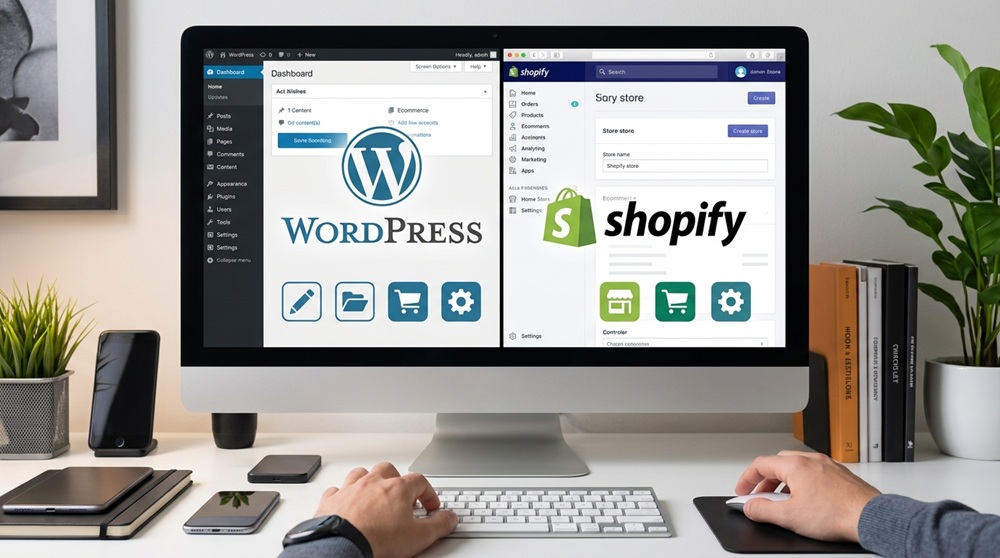
The most common question WordPress vs Shopify: Which Is Better, will be answered in this article.
Choosing between WordPress and Shopify can be difficult if you are planning to build an online store. Both platforms are popular, but they take very different approaches to website building and ecommerce.
The better choice depends on what you are selling, how much control you want, your technical experience and how you expect the business to grow. Neither platform is the perfect answer for every store.
WordPress vs Shopify: Quick Comparison
Shopify is generally the simpler option if your main goal is to launch and manage an online store without dealing with much technical setup. Hosting, security and core ecommerce functions are handled within the platform.
WordPress can be a better fit if you want greater control over your website, content and functionality. With WooCommerce, WordPress can be turned into a full ecommerce store, while also giving you access to a large content and blogging ecosystem.
Shopify is often easier for beginners, while WordPress can offer more flexibility for businesses with specific requirements. Your choice should therefore depend on whether simplicity or control is more important for your project.
WordPress vs Shopify: What’s the Difference?
WordPress is a content management system that can be used for many types of websites, including ecommerce stores. WooCommerce adds online selling features to a WordPress website.
Shopify is an ecommerce platform built specifically for selling products and services online. It combines the main parts of running an online store into one hosted solution.
With WordPress, you generally have more responsibility for choosing hosting, themes, plugins, updates and maintenance. Shopify handles much of the technical infrastructure for you.
That difference is important. WordPress can give you more freedom, but it can also require more management. Shopify can reduce the technical workload, but you work within the platform’s structure and available features.
WordPress vs Shopify Pricing
The cost of WordPress and Shopify depends on the setup you choose, so it is not useful to compare only the headline price.
With WordPress, the software itself can be used without a licence fee, but you may pay for hosting, a premium theme, plugins, development and maintenance. WooCommerce is also available as a free core platform, although extensions and additional services can add to the total cost.
Shopify uses subscription plans, with pricing varying by plan and market. You may also have costs for themes, apps and payment processing depending on your store.
WordPress can sometimes be more cost-effective for a business that already has hosting and development resources. Shopify may be easier to budget for because more of the infrastructure is included in the platform.
WordPress vs Shopify for SEO
Both WordPress and Shopify can be used to build search-friendly ecommerce websites. The platform itself is only one part of SEO.
WordPress gives you extensive control over content, URLs, metadata, internal linking and technical settings. With the right plugins and development setup, you can create a highly optimized website.
Shopify also provides many important SEO features, including editable page information, structured ecommerce functionality and tools for managing store content. However, some technical elements are more controlled by the platform.
For content-heavy businesses, WordPress has a particularly strong advantage because blogging and content publishing are central to the platform.
WordPress vs Shopify for Ecommerce
Shopify has a clear advantage in simplicity because ecommerce is its main purpose. Products, inventory, checkout, orders and other store functions are integrated into the platform.
WordPress becomes an ecommerce platform through WooCommerce. This approach can be more flexible because you can combine ecommerce with almost any type of content-driven website and customize the store extensively.
Shopify can be particularly attractive to a new business that wants to get products online quickly. WordPress and WooCommerce may be better suited to businesses that need unusual product structures, custom functionality or deep control over the website.
WordPress vs Shopify for Website Design and Customization
WordPress is usually the stronger choice if extensive customization is a priority. There are thousands of themes and plugins, and developers can make deeper changes to the website’s code and structure.
Shopify also offers a wide selection of themes and allows considerable design customization. Its theme system and development tools can support highly polished stores, but you are still working within Shopify’s platform.
For a business that wants a website that combines ecommerce with extensive content, custom landing pages and unusual functionality, WordPress can provide more freedom.
For a store that wants a clean, professional design without managing a large number of technical decisions, Shopify can be easier.
WordPress vs Shopify for Speed and Performance
Shopify handles much of the underlying hosting infrastructure, which can make performance management simpler for store owners. You still need to be careful with large images, third-party apps and unnecessary scripts because these can affect page speed.
With WordPress, performance depends heavily on your hosting provider, theme, plugins, database and development setup. A well-optimized WordPress site can be extremely fast, but a site overloaded with plugins and large files can become slow.
WordPress vs Shopify for Security
Shopify is a hosted platform, so much of the core server and platform security is managed by Shopify. Store owners still need to protect their accounts, use strong passwords and enable available security features.
With WordPress, the business and its development or hosting team generally have more responsibility for updates, plugins, themes, backups and server security. Using outdated software can create avoidable risks.
WordPress vs Shopify Pros and Cons
- WordPress offers more flexibility, customization and control.
- But it also requires more maintenance, hosting and security management.
- Shopify is easier to set up, manage and secure, making it ideal for beginners and dedicated ecommerce stores.
- But it has recurring costs and less flexibility.
Conclusion
WordPress gives you a lot of control over your website and can be extended with WooCommerce and thousands of plugins and themes. Shopify, on the other hand, is built specifically for ecommerce and provides hosting, checkout and many store management features in one platform.

