
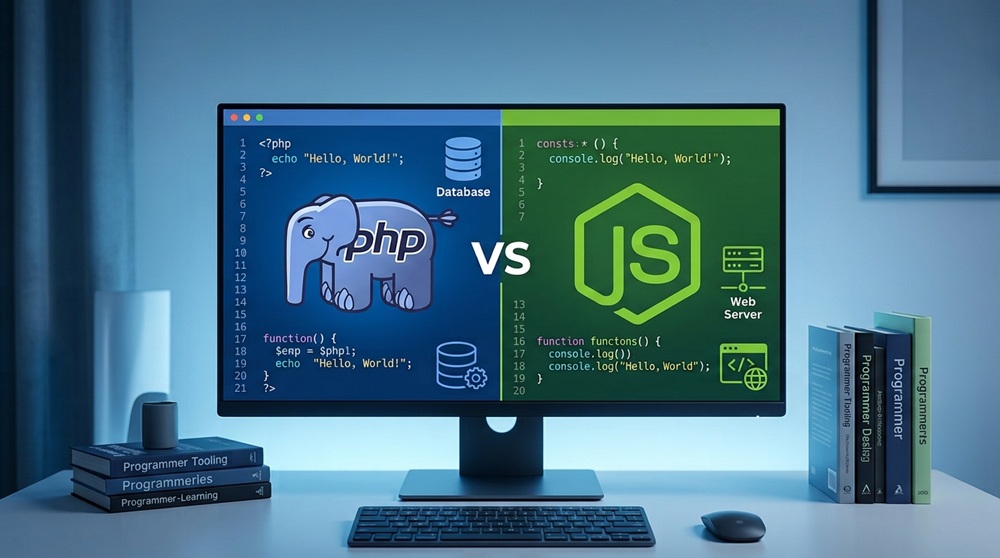
Choosing a technology for a new website or web application can feel complicated, especially when two popular options such as PHP and Node.js are being compared. Both can be used to build modern websites and web applications, but they work differently and suit different types of projects.
PHP has been used for web development for decades and powers a large number of websites, while Node.js allows developers to use JavaScript on the server as well as in the browser. Neither option is automatically better for every project.
PHP vs Node.js: Quick Answer
PHP is often a practical choice for content-driven websites, business websites, blogs, eCommerce stores and projects built around platforms such as WordPress. It has a mature ecosystem, widespread hosting support and a large developer community.
Node.js can be a strong choice for applications that need real-time communication, frequent data updates or a JavaScript-based development stack across the front end and back end. It is commonly used for APIs, dashboards, collaborative applications and other interactive web experiences.
PHP vs Node.js: At-a-Glance Comparison
PHP and Node.js can both handle modern web projects, but their strengths are different.
PHP uses PHP as its server-side language and is particularly common for websites, CMS platforms and eCommerce projects. Node.js is a JavaScript runtime and is widely used for APIs, real-time applications and custom web applications.
PHP has a very large CMS ecosystem and is supported by a wide range of traditional hosting providers. Node.js is especially convenient for teams that already use JavaScript on the front end.
What Is PHP?
PHP is a server-side programming language designed with web development in mind. When someone visits a PHP-powered website, the server processes PHP code and generates the response that is sent to the visitor’s browser.
It is closely associated with popular content management systems. WordPress, for example, is built primarily with PHP, which makes it a common choice for business websites, blogs and content-heavy sites.
The language has a mature ecosystem and has been used in web development for many years. Developers can choose from numerous frameworks, libraries and tools depending on the project.
What Is Node.js?
Node.js is a JavaScript runtime that allows developers to run JavaScript outside the browser. In web development, this means JavaScript can be used to build the server-side part of an application as well as the front end.
Node.js uses an event-driven, non-blocking approach that can handle many simultaneous connections efficiently, particularly for applications involving frequent input and output operations.
It is popular for APIs, real-time applications, chat systems, dashboards and other applications where users expect frequent updates without repeatedly refreshing the page.
PHP vs Node.js: How They Work
PHP and Node.js both run code on the server, but they use different approaches.
A PHP application typically processes a request on the server and generates a response. Modern PHP applications can use frameworks, caching and other techniques to handle large and complex websites.
There is the use of an event-driven architecture with an event loop by Node.js. It can manage many input and output tasks without blocking the application while it waits for operations such as database queries or file access to complete.
PHP vs Node.js Performance
Both PHP and Node.js can deliver good website performance when they are properly developed and hosted.
Node.js is often associated with strong performance for I/O-heavy applications because its non-blocking architecture can handle many concurrent operations efficiently. This can be useful for real-time features and applications that make frequent requests.
PHP vs Node.js Scalability
PHP applications can use caching, load balancing, database optimization and multiple application servers to support increasing traffic. Its mature hosting ecosystem also provides established ways to scale PHP-based websites.
Node.js can scale horizontally by running multiple application instances and distributing traffic between them. Its event-driven model can also be useful for applications that need to maintain many concurrent connections.
PHP vs Node.js Frameworks
PHP developers commonly work with frameworks such as Laravel and Symfony. These provide structures and tools for routing, databases, authentication, validation and other common application features.
Node.js developers can choose from frameworks such as Express, NestJS and Fastify. The ecosystem also includes many tools for building APIs and full web applications.
PHP vs Node.js Hosting
PHP has an advantage when it comes to traditional shared hosting. Many hosting providers support PHP, and deploying a basic PHP website can be relatively straightforward.
Node.js hosting is also widely available, particularly through cloud platforms and managed hosting providers. However, the setup can be different because Node.js applications often require an application runtime and appropriate server configuration.
PHP vs Node.js Developer Experience
PHP has a long-established developer community, extensive documentation and a large number of existing projects and tools. Finding developers with PHP experience can be relatively straightforward.
Node.js benefits from the popularity of JavaScript. Developers who already work with JavaScript on the front end may find it convenient to use the same language on the server.
Node.js also has a large npm ecosystem, which gives developers access to packages for many different functions.
PHP vs Node.js SEO
Neither PHP nor Node.js automatically makes a website better for SEO. Search performance depends on how the website is built, how quickly pages load, the quality of the content, mobile usability, technical SEO and many other factors.
PHP websites can generate HTML on the server, making it straightforward to deliver content that search engines can crawl.
Node.js applications can also be highly SEO-friendly. Developers can use server-side rendering, static generation or other approaches to make important content available to search engines.
Conclusion
Both capable technologies for modern web development, but they are best suited to different situations. PHP remains a strong choice for traditional websites, CMS-based projects, business websites and eCommerce platforms, particularly when ease of hosting and content management are important.
Node.js is an attractive option for custom applications, APIs and real-time experiences where asynchronous communication and a JavaScript-based stack are useful.

