



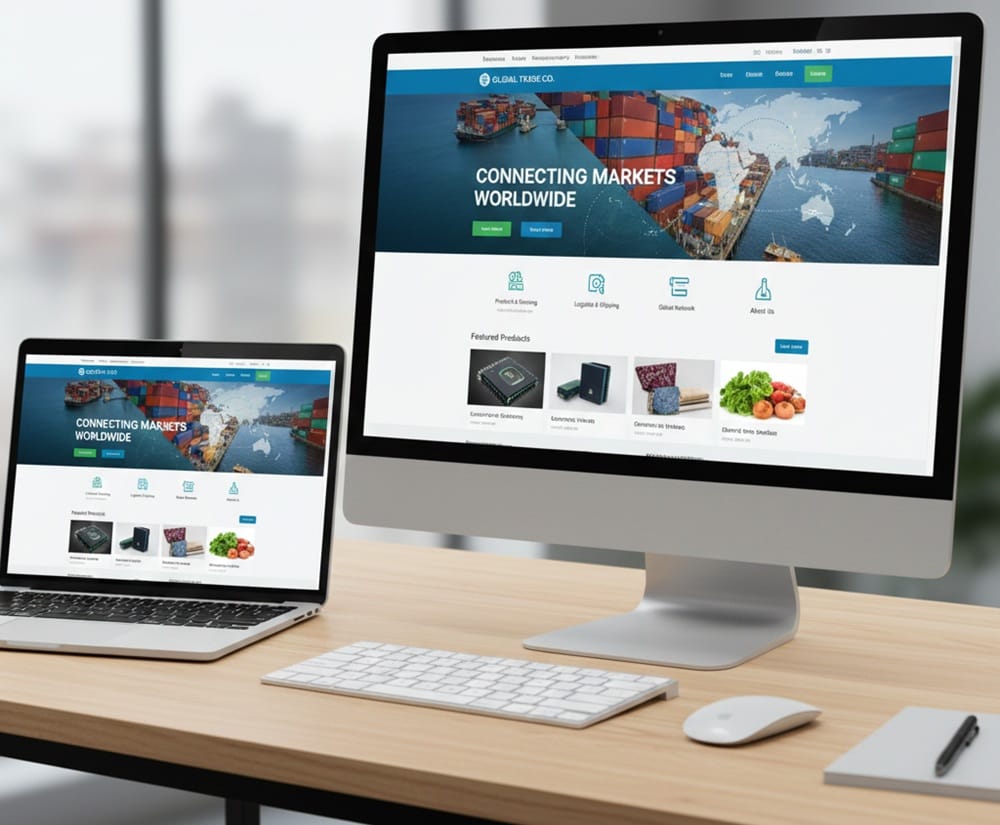
Looking for website design for export business?
What should an export business consider when having a website? Considering a website a mere showoff for online presence will surely kill the buzz. Instead, turn it into a global showroom and sales channel.
Let international buyers, distributors, and partners find your business on your website. But how can you achieve the breakthrough you want? Figure out the essentials of a professional export business website.
Unique Needs of Export Businesses
Export businesses face unique digital challenges compared to domestic firms. A well-structured export-focused website acts as a global showroom, showcasing product quality, certifications, and credibility.
Attracting International Buyers
Optimize for keywords in multiple languages and regions. A modern, mobile-friendly site signals credibility. 75% of users judge a company’s credibility based on website design.
Generating Qualified B2B Leads
Inquiry forms, downloadable catalogs, and integration with B2B marketplaces (Alibaba, B2BMAP) help filter serious buyers. Export websites should connect with CRM systems to track leads and nurture relationships.
Showcasing Product Quality and Certifications
High-resolution product images, factory tours via video, and downloadable certificates build trust. Prominently feature certifications like ISO 9001, CE, or country-specific approvals.
Catering to Multiple Countries, Cultures, and Time Zones
Websites should offer language options (English, Chinese, Arabic, and Spanish) to reach a wider audience. Colors, symbols, and imagery must be adapted. Automated chatbots and inquiry acknowledgment emails let buyers receive instant replies.
Core Features: Export Business Website
A strong export website should deliver credibility, discovery, and conversion across borders. And you’ll need essential features to impress international buyers and B2B decision-makers.
Professional Homepage with Clear Value Proposition
- Positioning Statement: The first screen should state who you serve, what you export, and why you’re reliable. A homepage that functions as a global showroom sets the tone for trust and lead generation.
- Credibility Anchors: Use trust signals like certification badges (ISO/CE/FDA/Halal), dates, country coverage, and industry memberships. Global buyers rely on these cues to assess professionalism.
- Conversion-Ready Design: Present clear CTAs like “Request a quote”, “Download catalog”, and “Contact sales” to reduce friction and guide international visitors to action. Clean, modern, mobile-responsive layouts support credibility for overseas procurement teams.
Product Catalogs with Detailed Specifications
- Structured Data: Publish SKUs with dimensions, materials, tolerances, HS codes, MOQ, lead time, incoterms, packaging, and compliance. Engineers and procurement teams expect technical clarity.
- Downloadables: Offer region-specific datasheets (PDF) and multi-language catalogs to support procurement workflows and internal approvals for B2B buyers.
- Rich Media: Always include high-resolution photos, 360° views, and short factory or QA videos. Clear visual proof reduces uncertainty and increases inquiry quality.
Inquiry Forms and RFQ Systems
- RFQ Workflows: Build forms that capture procurement-grade details: product codes, target quantities, destination country/port, preferred incoterms, certification requirements, and timelines. It saves sales time and increases quote accuracy.
- Tiered Forms: Use quick inquiry (name, email, product) and advanced RFQ (technical specs, logistics preferences). Gated downloads (spec sheets, pricing tiers) help qualify serious buyers while supporting lead capture.
- Automated Acknowledgments: Auto-reply with “Thank you + next steps,” estimated response time, and a link to schedule a call in the buyer’s time zone. Immediate confirmation builds trust when operating across continents.
Company Profile and Export Experience
- Authority Narrative: Share your export journey—years in operation, top markets, annual capacity, and logistics partners. Export buyers look for operational maturity, not just product features.
- Compliance and QA: Detail your quality systems (e.g., ISO 9001), testing protocols, and traceability. Display certification badges and downloadable certificates to remove doubt for regulated markets.
- Social Proof: Add case studies, client logos (where permitted), trade fair participation, and awards. Supplier verification content reassures buyers when comparing multiple international vendors.
Contact Options for International Communication
- Multi-Channel Access: Provide region-aware contact – email, international numbers, WhatsApp/WeChat, and an auto-adjusting schedule link for time zones. Frictionless communication is critical for cross-border trust.
- Regional Routing: Use smart routing (“EU inquiries” vs “APAC inquiries”) and publish business hours in GMT with expected response times. Buyers appreciate clarity on availability and escalation paths.
- Live Chat with Handoff: Offer live chat for quick questions and ensure handoff to sales with a transcript. Pair with an FAQ that covers shipping terms, payment options, and lead times to reduce back-and-forth.
Simple Navigation and International-Friendly Structure
No matter what you’re trying to do, a steady navigation through an international-friendly structure is mandatory. Otherwise, your business website may take a hit on usability, trust, and lead generation.
Intuitive and Straightforward Menu Structure
Export buyers often visit websites with a specific purpose—finding product specs, certifications, or contact details. A cluttered or confusing menu increases bounce rates.
Keep menus short (5–7 main items) with clear labels like Products, Certifications, RFQ, About Us, and Contact. Use sticky navigation bars so menus remain visible while scrolling.
Categorized Product Listings for Easy Discovery
Group products by category, industry, or application. For exporters, categories like Textiles → Cotton, Jute, Synthetic or Machinery → Agricultural, Industrial, Spare Parts make browsing intuitive.
Add filters for specifications (size, material, certification) and a search bar with autocomplete. It significantly reduces friction for buyers comparing multiple suppliers.
Logical Internal Linking for Better Usability and SEO
Internal links guide buyers from product pages to RFQ forms, certifications, and the company profile. You can reduce potential drop-offs and increase inquiries.
Google rewards logical linking structures. So, link product pages to case studies or testimonials. Add “Related Products” sections to encourage exploration.
Avoiding Clutter and Unnecessary Distractions
Export buyers value clarity. Avoid autoplay videos, pop-ups, or excessive animations that slow page load times. Cleaner layouts, product-focused visuals, and minimal distractions help exporters stand out in crowded global markets.
Prioritize whitespace, concise copy, and clear CTAs. Every element should serve a purpose—either to inform or to convert.
Multilingual and Multi-Region Website Design
Don’t take ‘design for multiple languages and/or regions’ as some blind translation. You can earn trust at first sight in buyer journeys, signaling operational maturity to international partners.
- Native-Language Clarity: Global buyers evaluate suppliers fast. Presenting product specs, certifications, and RFQ steps in their language reduces misunderstandings, accelerates decisions, and minimizes back-and-forth emails.
- Cultural Resonance: Localization adapts tone, visuals, units, formats, and references so content feels “made for me”. Color meanings, formality levels, and imagery differ by market; getting them right makes your brand feel trustworthy and professional.
- Operational Confidence: Export buyers look for solid proof (validity) of your ability to serve their niche market. Localized compliance (EU CE, GCC standards), shipping terms, and payment options signal readiness for cross-border trade.
Product Presentation and Catalog Design
High Quality Product Images and Technical Descriptions
- Visual Proof: Use crisp, well-lit images, consistent backgrounds, multiple angles, and context shots (in use, packaging, labeling). Add 360° spins or short QA videos where relevant to reduce uncertainty for first-time buyers.
- Technical Depth: Pair each image with a concise, structured description that includes materials, finishes, tolerances, operating ranges, compliance marks, and application notes. Engineers and procurement specialists need clarity that enables apples-to-apples comparisons, not marketing fluff.
Downloadable Catalogs, Datasheets, and Brochures
- Procurement-Friendly Assets: Offer product datasheets and catalogs in downloadable PDFs, organized so teams can share internally and attach them to approval workflows. Centralizing SKUs, images, and specs in a maintained catalog reduces errors and speeds updates across teams.
- Templates and Consistency: Use a standardized datasheet template with fields for attributes, compliance, and tiered pricing. Tools that streamline datasheet creation and embed order forms can support quicker inquiries for B2B buyers.
- Versatile Formats: Provide brochures for overview storytelling, catalog PDFs for breadth, and individual datasheets for depth. Curated templates help maintain brand consistency across customer-facing and internal lists.
Clear Product Categories, SKUs, and Specifications
- Information Architecture: Categorize by product type, industry, or application (Machinery → Agricultural → Implements/Spare Parts). It reduces search friction for international buyers working under time constraints.
- SKU Discipline: Give every item a unique SKU and maintain consistent naming conventions. Centralized catalog workflows make it easier to update SKUs, attach images, and route reviews without “sheet sprawl”.
- Specs that Matter: Include HS codes, sizes, materials, performance ratings, compliance marks, MOQ, lead times, packaging details, recommended incoterms, and typical destination ports for standard routes.
Highlighting Customization Options and MOQ (Minimum Order Quantity)
- Customization Clarity: Specify configurable attributes (dimensions, colors, finishes, labeling, private label options), minimum customization runs, and any tooling/mold fees. Show examples with annotated images to set expectations.
- MOQ Transparency: State MOQ prominently on product pages and datasheets, with rationale (batch size, packaging, freight optimization). Include price break tiers if applicable to help buyers plan orders.
- Lead Times and Logistics: Pair MOQs with lead times for different incoterms (EXW/FOB/CIF) and add peak-season notes so buyers can forecast delivery windows. Add an RFQ shortcut on each product page with SKU, customization, MOQ, and destination.
International trade is simultaneously sensitive, competitive, and lucrative. And your website can open the door to global opportunities when it is designed and functions correctly. Every element mentioned in the article works together to transform your site into a powerful showroom that speaks directly to international buyers.
Contact Tectera a website design company for website design for export business.
Frequently Asked Questions
Detailed catalogs with high-quality images, SKUs, HS codes, specifications, and downloadable datasheets help buyers easily compare products and increase inquiry conversion rates.
RFQ forms capture buyer details, quantities, certifications, and destination ports, filtering serious leads and enabling accurate quotations.
Customer reviews and case studies provide social proof, showing successful exports and satisfied clients, which strengthens buyer confidence.
Use HTTPS, SSL certificates, encrypted inquiry forms, GDPR compliance, and secure admin access to protect buyer data and build trust.
Combine simple navigation, multilingual support, SEO optimization, RFQ systems, and trust signals. It should help exporters attract serious buyers and convert them into long-term partners.
