



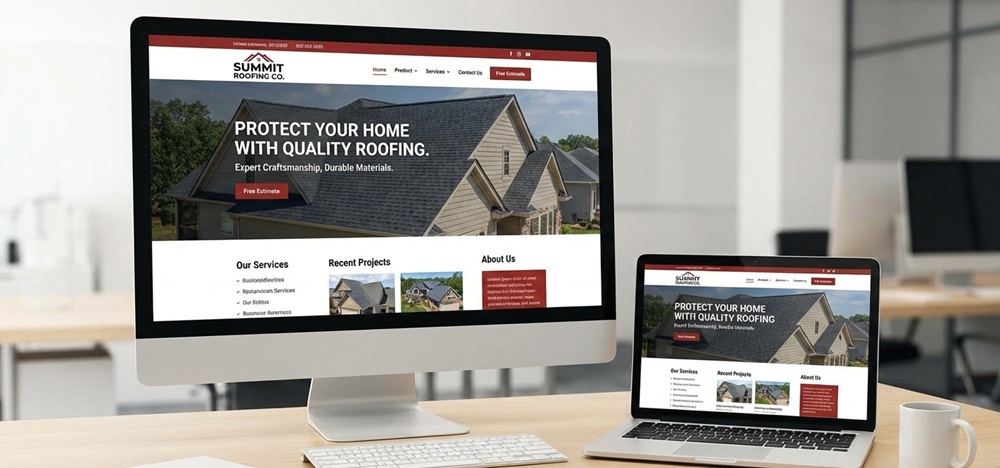
Looking for website design for roofing company?
Almost every company should maintain a well-structured website, including a roofing company. It can act as a 24/7 sales representative working tirelessly to attract, inform, and convert potential customers.
Table of Contents
ToggleSomeone may search for emergency roof repair or compare contractors; your site should make the first impression. Explore how specific site elements transform a simple site into a powerful business tool.
Essential Features of an Effective Roofing Website
A roofing website should exist, function, and convert. You need all the core features to work together to build trust and nudge visitors to call, book inspections, and request quotes.
Clear service listings
A straightforward, scannable service menu helps customers quickly find what they need and signals professional credibility. Homeowners often skim for exact services (repair, replacement, inspection, installation) before reading deeper.
Specific services reduce hesitation and create “solution fit,” prompting calls or form submissions. Organized, comprehensive listings show you’re equipped for diverse roofing needs.
How to Implement?
- Structured Menu: Group services into primary (repair, replacement, inspection, installation) and secondary (gutter work, skylights, ventilation, waterproofing).
- Service Pages: Create a dedicated page for each service with an overview, process, materials, warranties, photos, FAQs, and a clear CTA.
- Microcopy: Add “When to choose repair vs replacement” and “Typical timelines” as short blurbs for quick decisions.
- Lead with Outcomes: “Stop leaks fast,” “Extend roof lifespan,” “Prevent hidden damage”. Add a simple “Is this for you?” section with 3–5 bullets per service.
Contact Information and Call Buttons
Make it effortless to call or message—especially on mobile, where decisions happen fast. Roofing issues are urgent; delays cost you leads. Tap-to-call reduces friction and drives more inquiries. Visible contact details communicate reliability.
How to Implement?
- Sticky Header: Keep phone number and “Get a quote” button visible at all times. Use a large, contrasty call button with “Call now—free estimate.”
- Multiple Channels: Offer phone, WhatsApp, email, and a short inquiry form in the header and footer. Repeat contact blocks after key content sections and near testimonials.
- Smart Routing: Use call-tracking numbers for each campaign (Google, Facebook, door hangers) to see which converts best.
- Availability Cues: Add “Open now • Response in under 10 minutes” during business hours, and “We’ll call you first thing in the morning” off-hours.
Online Estimate or Inspection Request Forms
Forms transform interest into scheduled leads—when they’re fast, transparent, and credible. Many users prefer asynchronous requests over calling. Smart fields capture job details without overwhelming users. Promises like “No obligation” and “Transparent pricing” reduce resistance.
How to Implement?
- 2-Step Form: Step 1 – name, phone, email, address. Step 2 (optional) – roof type, issue type, photo upload.
- Inline Proof: Show “Licensed & insured” badges, response times, and short privacy assurance.
- Dynamic CTAs: “Get a same-day estimate,” “Book a free inspection,” “Upload a photo—get quick advice.”
- Micro-Surveys: Add a single-choice field—”What’s your biggest concern?” (Leak, age, storm damage, resale).
- Auto-Replies: Send a confirmation email/SMS with the following: the steps, the expected timeline, and a calendar link.
- Form UX: Keep labels outside fields, show progress, and use clear error states. Avoid long required text inputs.
Emergency Roofing Service Highlights
When the roof fails, the first contractor who signals readiness wins the call. Emergency visitors convert quickly if they see immediate help and straightforward steps. Visible readiness (24/7, arrival windows) reduces panic and uncertainty.
How to Implement?
- Dedicated Emergency Page: Prominent link in the header; headline like “24/7 emergency roofing—on-site today”.
- Rapid CTA: “Call now—dispatcher connects in 2 minutes,” plus a one-field callback form.
- Process Clarity: Outline emergency triage: temporary tarping, safety checks, moisture control, next-day inspection.
- Service Windows: Display realistic arrival times (e.g., “Within 2–4 hours in our core zones”).
- Preparedness: List emergency toolkit readiness (tarp sizes, sealants, ladder specs) without jargon.
- Social Proof: Add 2–3 short emergency testimonials highlighting speed and professionalism.
Service Area Coverage Pages
Service area pages are local intent magnets—critical for search visibility and trust. Customers want a nearby contractor who understands local materials, codes, and climate. City-specific pages often rank for “roofer near me” and “roof repair + city”.
How to Implement?
- City Pages: Create tailored pages for each city/region featuring localized photos, landmarks, and neighborhood names.
- Local Proof: Include permit know-how, typical roof types, and average project timelines relevant to the area.
- Map and Radius: Add a coverage map, core zones, and extended service areas with clear response times.
- Structure: Use consistent templates: intro, services, local FAQs, case studies, testimonials, CTA.
- Internal Linking: Link city pages to relevant service pages and a “See our work near you” gallery.
- NAP Consistency: Ensure the name, address, and phone number are identical across the site and directories to support local visibility.
Homepage Design for Roofing Companies
The homepage is the digital front door to your business. It marks the first touchpoint for potential clients, and within seconds, visitors decide whether to trust, engage, or leave.
Clear Value Proposition and Service Promise
55% of visitors spend less than 15 seconds on a website before deciding whether to stay. A concise value proposition immediately communicates what sets your roofing company apart—speed, reliability, affordability, or expertise.
- Headline Clarity: Use a bold statement like “Protecting Your Home with Reliable Roofing Solutions—24/7 Service You Can Trust.”
- Subtext Promise: Add a short supporting line: “Licensed, insured, and serving [City] homeowners for over 20 years.”
- Customer-Centric Language: Focus on benefits (“Leak-free guarantee,” “Energy-efficient installations”) rather than just listing services.
Above-the-Fold Call-to-Action (CTA) Placement
70% of small business websites lack a clear CTA above the fold, leading to lost conversions. Roofing customers often arrive with urgent needs (leaks, storm damage). A visible CTA ensures immediate action.
- Primary CTA: Place “Request a Free Estimate” or “Call Now” button prominently in the header.
- Secondary CTA: Add “Schedule Inspection” or “Upload Roof Photos” for convenience.
- Sticky Elements: Keep phone number and CTA visible as users scroll.
Trust Elements: Licenses, Certifications, and Experience
88% of consumers say trustworthiness is the most crucial factor when choosing a local contractor. Roofing is high-stakes—customers want proof of legitimacy before inviting workers onto their property.
- Badges and Logos: Display manufacturer certifications (e.g., GAF Master Elite, CertainTeed Select ShingleMaster).
- Years of Experience: Highlight longevity (“Serving homeowners since 1995”).
- Insurance and Licensing: Add clear statements like “Fully licensed and insured in [State/Region].”
- Testimonials: Showcase short quotes with star ratings or video snippets.
In Germany, TÜV certification logos build credibility. In the US, BBB accreditation and Google review ratings are key. In Asia, government registration numbers are often displayed prominently.
Use of High-Quality Roofing Images and Project Visuals
- Visuals to Perception: 67% of consumers say product/service images are “essential” in their buying decision. Roofing is tangible—customers want to see the quality of work.
- Hero Image: Use a high-resolution photo of a completed roof project, ideally with a smiling homeowner or team.
- Before-and-After Gallery: Show transformations (damaged roof → new installation).
- Video Walkthroughs: Short clips of inspections or installations build transparency.
- Local Relevance: Use images of homes typical to your service area (tile roofs in Spain, asphalt shingles in the US, corrugated sheets in South Asia).
Service Page Design and Structure
A high-performing roofing website turns each service page into a focused conversion path—clear, credible, and action-oriented. Treat these pages as standalone landing pages that can rank, persuade, and convert on their own.
Dedicated Pages for Each Roofing Service
Create one page per core service (repair, replacement, inspection, installation) and specialized offerings (storm damage, gutters, skylights, ventilation). It improves search visibility, clarity, and conversion.
- Service-Specific Intent: Write for a single need per page; avoid mixing multiple services, as this dilutes relevance.
- Localized Context: Reference materials and roof types common in your area (asphalt, metal, shingle, tile, corrugated), as well as local code/permit nuances.
- Proof Elements: Add certifications, warranties, and relevant case studies aligned to that service (manufacturer-approved installation badges on the installation page).
- FAQ Depth: Answer practical questions: timelines, disruption, pricing drivers, insurance documentation, and warranty transferability.
Use the Service and FAQ schema per page to strengthen rich results and local visibility. Also, cross-link related services (“Leak repair” → “Emergency tarping” and “Replacement”).
Clear Explanation of Processes and Benefits
Clarity reduces anxiety and speeds decisions. Break down the process into steps, then translate each step into customer benefits.
- Assessment: On-site inspection, moisture detection, photo documentation, and safety checks.
- Plan and Estimate: Scope, materials, timeline, permit requirements; transparent estimate with options.
- Execution: Crew arrival, site protection, work stages, quality checks.
- Finalization: Cleanup, walkthrough, warranty handover, maintenance tips.
Before-and-After Images
Visual proof accelerates trust and reduces perceived risk. Show transformations, not just final results.
- Consistent Angles: Capture the same vantage point before and after for clarity.
- Annotated Visuals: Short labels like “Leak around chimney—flashing replaced,” “Wind damage—shingle reinstallation.”
- Diverse Roof Types: Showcase projects across materials (tile, shingle, metal, flat/EPDM/TPO) to signal versatility.
- Lightweight Galleries: Optimize image sizes and lazy-load; add alt text with service-specific keywords.
Pair each image set with 2–3-sentence narratives: issue, solution, outcome, and timeline. 20–60 second walkthroughs (inspection highlights, installation progress, final quality check).
A roofing company with a well-designed website is an engine to drive growth, trust, and engagement. Every section of your site must work together to transform visitors into loyal clients. Maintaining with fresh content, updated testimonials, and continuous improvements makes your website a living sales representative that never sleeps.
Contact Tectera a web development company in Toronto for website design for roofing company.
Frequently Asked Questions
Your homepage should feature a clear value proposition, service listings, trust badges (licenses, insurance), high-quality visuals, and a strong CTA above the fold, such as “Request a Free Estimate.
By strategically placing CTAs, using short contact forms, enabling live chat, and optimizing service pages, roofing websites can increase quote requests and calls. You can achieve 30%-40% lead growth.
Dedicated service pages (repair, replacement, inspection, installation) improve SEO and help quickly find what’s needed. Each page should explain the process, benefits, and include before-and-after images.
Local SEO ensures your company appears in the Google Map Pack for searches like “roof repair near me”. Optimized NAP (Name, Address, Phone) consistency and city-specific landing pages are critical.
Showcasing licenses, insurance, and manufacturer certifications (GAF Master Elite) reassures customers of compliance and expertise. These badges should be visible near CTAs and service descriptions.
